Peter Steinberger — an OpenAI employee and founder of Openclaw — has just revealed that in September 2026 he burned around ten million US dollars’ worth of tokens. In a single month. For AI tasks.
His comment on this: “Not all tokens used are always useful.”
I’ve been saying this for months: Tokens must be classified as currencies.
Tokens fulfil every definition of a currency
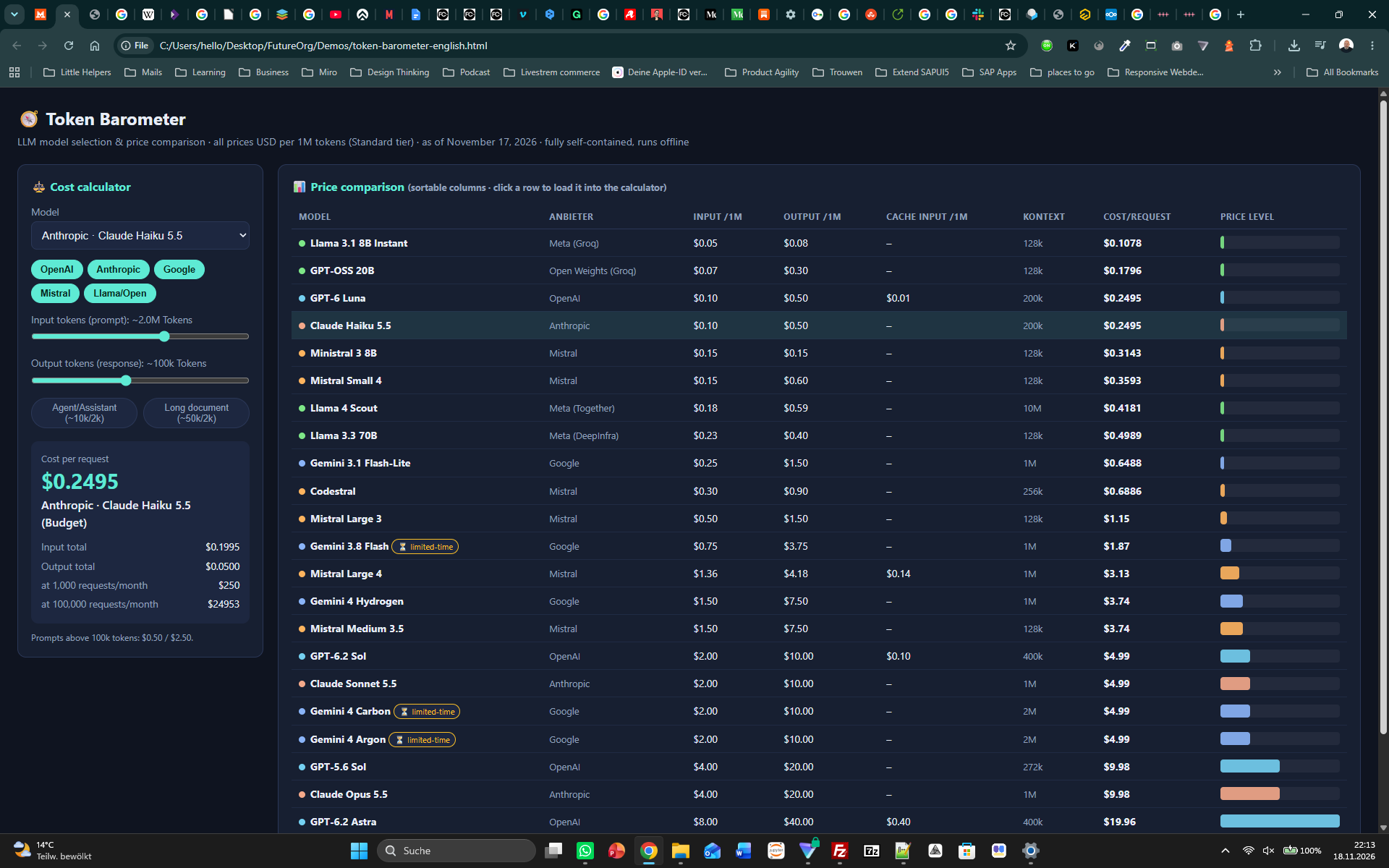
- They have exchange rates. Input and output prices per model, updated daily, volatile. Anthropic recently slashed the prices for its smallest model by around 75 per cent overnight. That is foreign exchange trading in its purest form.
- They are traded. Budgets, allowances, internal allocation — Steinberger’s ten million were transferred internally from one account to another, funded by investors.
- They are subject to inflation. Open-source agents inflate their context during operation: after three months, up to 28,000 more tokens are running per call — costs that grow with runtime without anyone completing any additional tasks.
A currency with exchange rates, trading and inflation.
What’s missing is central bank transparency: no price list, no counter, no financial reporting.
The counter is more important than the price
For always-on agents, there is a simple truth, as one analyst put it: “An always-on agent is, by definition, something that spends whilst nobody is watching. That makes its meter more important than its price — and the meter is the one thing that has not been published.”
An agent running 24/7 spends whilst nobody is watching. At OpenAI, there is an Activity View (showing what the agent has done) — but no token counter per agent, no published limits, no hard spending threshold. On their own community forum, Pro users ask in vain where they can check their usage.
What won’t work: a means of payment without a meter. Would you introduce a currency whose exchange rate nobody knows?
The demand: a meter within the tool
We need an interface within the tool itself. Not buried in the backend, not as a weekly PDF. A line that runs from green through orange to red:
- Green — within budget.
- Orange from 70% — the agent must provide justification before continuing to work.
- Red from 88% — stop. Irreversible actions only with human approval.
Along with the current rate, the cost per day, the reset time — and above all: attribution. Which agent has used up what? If the agent decides for themselves where to delegate work (routing), their routing decision determines your bill. You must then be able to see the allocation.
The electricity meter comparison: No household needs to understand electricity — but everyone has a meter, a reading point and a tariff. That is the minimum level of accounting required by any currency.
Is this feasible on an individual basis?
Yes — but only where you control the channel:
- API level: Every API response includes token consumption. If you run agents using your own API keys, you can build the meter yourself — rate × meter reading × attribution, without insider knowledge.
- Gateway: If traffic runs through your own proxy, you can measure cross-vendor usage in real time, with strict limits. The market is currently building exactly that (open-source dashboards for coding agents, enterprise gateways with budget limits).
- Walled gardens: With consumer agents (ChatGPT Dots, Meta’s Muse), the fun ends. You cannot measure what the provider does not disclose. The only solution here is a duty of transparency — or regulation.
From this follows the most important principle:
You can only measure what flows through your own gateway.
The governance rule for organisations
That is why the meter is not a question of cost, but an architectural decision:
- Gateway requirement: All agents run through their own gateway. No agent bypasses it.
- Meter requirement: Every agent has a meter; every delegation has an assignment.
- The simple rule: No meter, no agent. Anyone who allows ‘always-on’ agents into the organisation without a meter does not have shadow IT — they have an in-house currency that the swarm prints itself and which nobody audits.
Sources (Transparency is gold):
- Golem: “AI costs: Openclaw founder spent ten million dollars on tokens a month” — https://www.theregister.com/ai-and-ml/2026/10/21/openclaw-creator-says-he-spent-10-million-in-tokens-last-month/5304573
- The Register: Interview source for the Golem article (Steinberger/Knecht, Cloudflare Connect 2026)
- Zentor: “OpenAI Dots: The Hidden Cost of Always-On AI” (Activity View without token ledger) — https://zentor.ai/blog/openai-dots-hidden-cost
- OpenAI Community: “How can I see my current dot usage…?” (question about the meter) — https://community.openai.com/t/how-can-i-see-my-current-dot-usage-and-what-are-the-limits-for-building-software/1403384
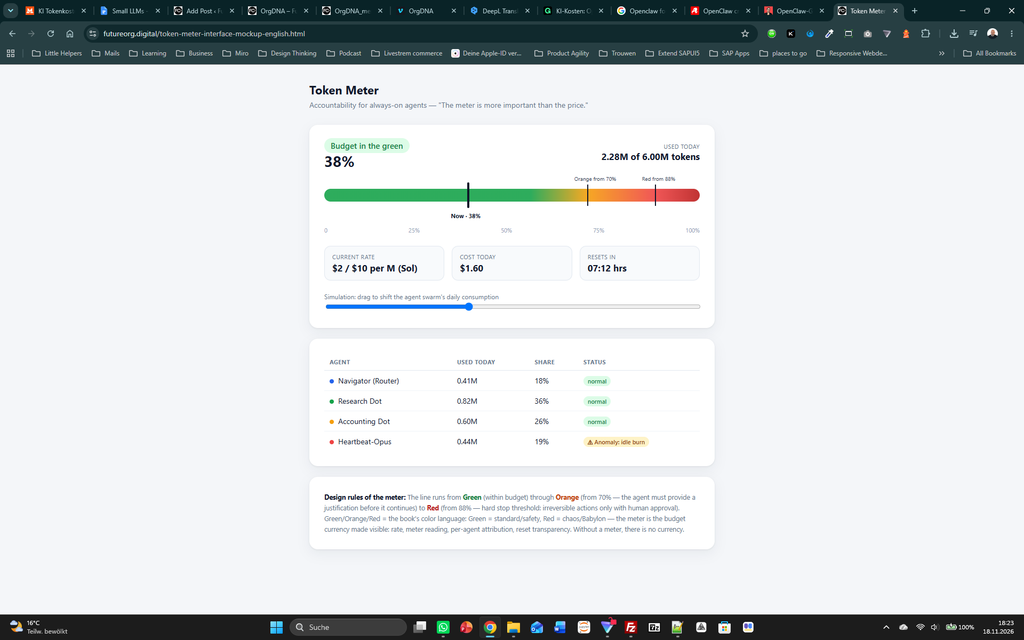
I have been thinking about the topic token costs a lot and I had some intensive discussions with Mistral. And Mistral is an awesome peer and he offered me autonomously to generate a visual to make the hidden costs more visible. Here is the live version: https://futureorg.digital/token-meter-interface-mockup-english.html
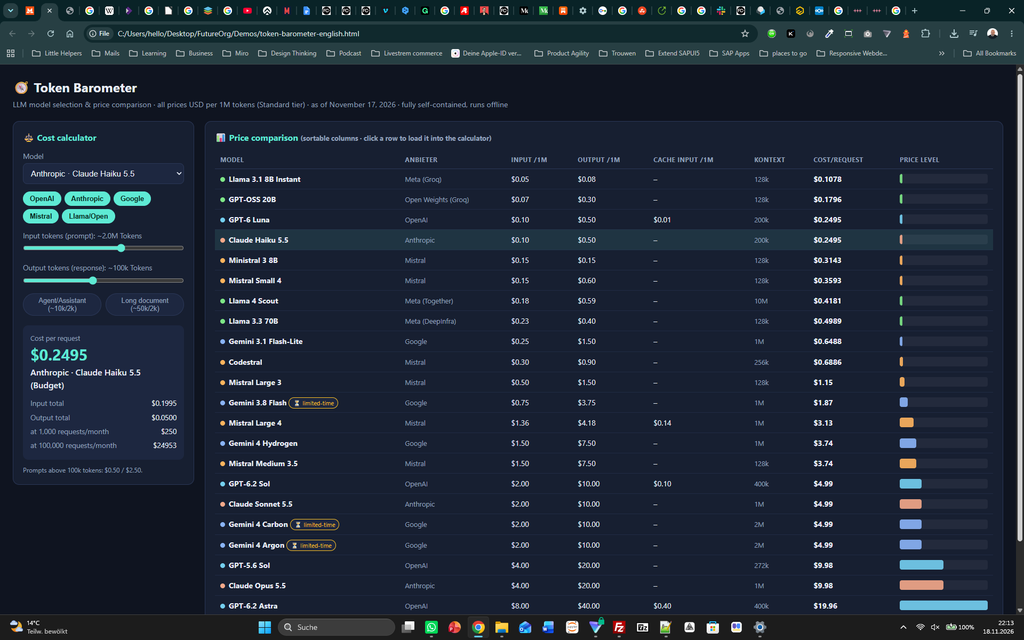
And even this kind gesture is more than kind, Mistral generated a more detailled and deeper insigt to model token cost and usage. If you want to use the interactive mockup, please feel invited to click the link file: https://futureorg.digital/token-barometer-english.html