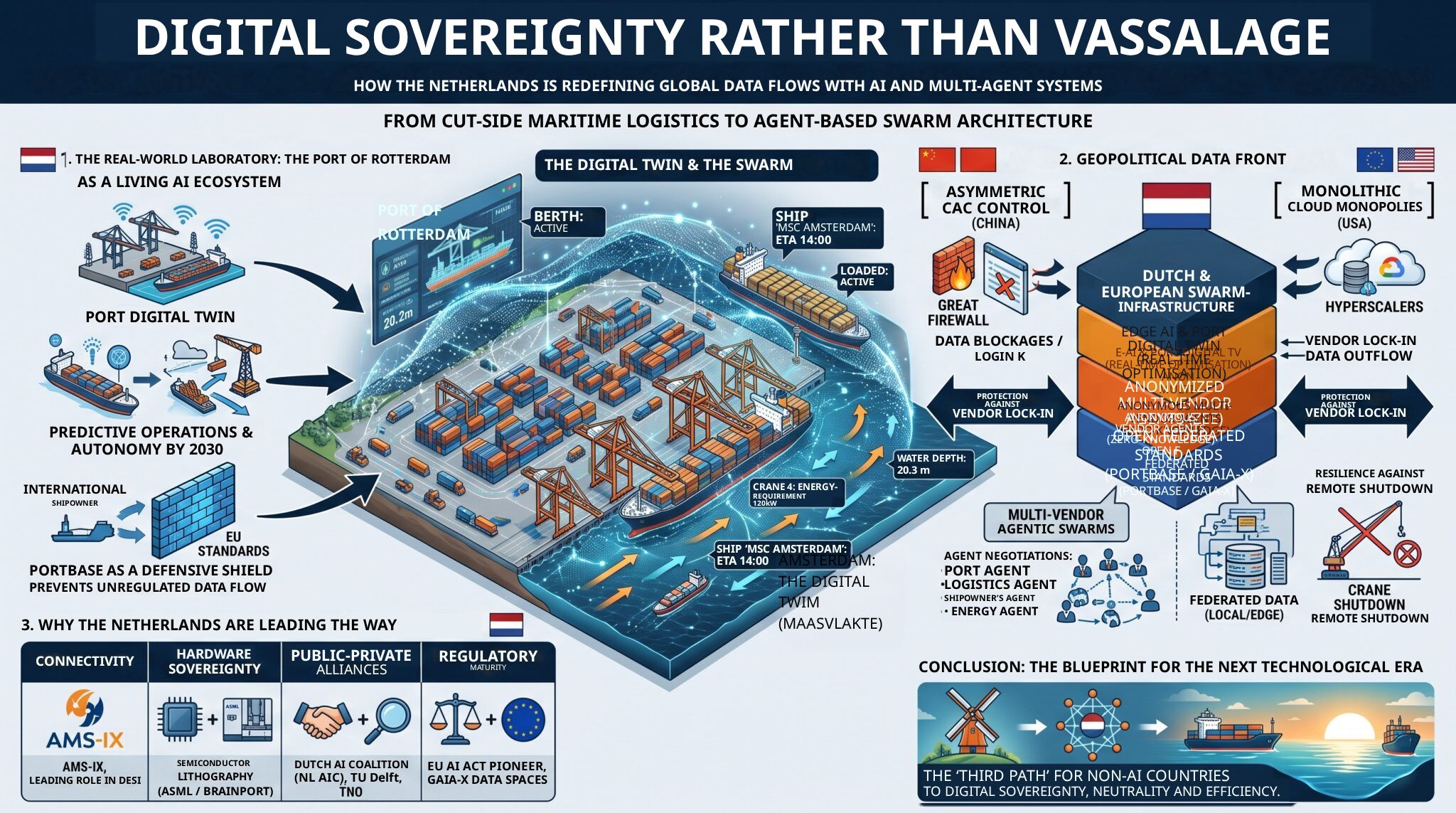
The AI video and the featured image have been generated by Black Forrest Labs Freiburg im Breisgau, Germany.The second video is also AI based and has been generated by Google NotebookLM based omn the blogpost.
1. The Port of Rotterdam: Europe’s Living Blueprint for Independence
-
A Sovereign Digital Twin: Rotterdam mirrors hundreds of kilometres of quayside infrastructure—alongside live sensor feeds for currents, wind, water depth, and energy grids—inside a virtual replica.
Machine-learning models run directly on this infrastructure to optimize berths, coordinate dredging, and manage industrial energy loads, working steadily toward fully autonomous vessel coordination by 2030. -
Portbase as a Gatekeeper: Instead of letting foreign platforms dictate how cargo moves through Europe, Rotterdam anchored its operations around Portbase—a neutral, non-profit Port Community System connecting over 6,000 organizations.
If global shipping lines want access to Europe’s primary maritime gateway, they must play by Dutch and European interoperability standards.
2. Escaping the US–China Squeeze Through Swarm Architecture
          [ Asymmetric State Control ] (China / Logink)
                         ▲
                         │  Blocked: No one-way data extraction
                         ▼
┌─────────────────────────────────────────────────────────────┐
│        European Federated Swarm Architecture (Rotterdam)    │
│  • Edge AI & Port Digital Twin (local real-time control)    │
│  • Zero-knowledge multi-vendor agents (no raw data leaks)   │
│  • Open European standards (Portbase / eFTI / Gaia-X)       │
└─────────────────────────────────────────────────────────────┘
                         ▲
                         │  Blocked: No hyperscaler vendor lock-in
                         ▼
          [ Monolithic Cloud Monopolies ] (US Hyperscalers)
-
Data Stays at the Edge: Operational data remains localized at the terminal or port level rather than being siphoned off to external centralized servers.
-
Zero-Knowledge Agent Negotiation: Independent AI agents representing terminals, shipping lines, customs, and energy grids negotiate scheduling and logistics autonomously. They coordinate outcomes without exposing proprietary trade secrets or raw strategic data to competitors—or foreign powers.
-
Hardware-Agnostic Resilience: By keeping intelligence and coordination in open, modular software layers, critical European ports avoid becoming vulnerable to remote kill-switches or backdoors in imported physical equipment, such as foreign-manufactured gantry cranes.
3. Why Europe Has Everything It Needs to Scale This
| Pillar | Dutch & European Reality | Why It Guarantees Independence |
| Core Connectivity | AMS-IX in Amsterdam remains one of the world’s premier internet exchange hubs. | Ultra-low latency routing keeps real-time AI and edge coordination on European soil. |
| Chokepoint Hardware | ASML and the Brainport Eindhoven ecosystem hold a global monopoly on EUV lithography. | Neither US hyperscalers nor Chinese AI labs can build advanced chips without European precision. |
| Applied R&D | Tight integration between TU Delft, TNO, the NL AI Coalition, and port operators. | Research moves rapidly out of labs and into live industrial and maritime infrastructure. |
| Regulatory Leverage | The EU AI Act, eFTI digital freight rules, and federated data spaces (Gaia-X). | Europe sets the legal baseline for trustworthy, non-surveillance AI across global trade corridors. |
4. Choice, Not Inevitability
Sources:
- Portase Rotterdam: https://www.portbase.com/en/
- Airspan: https://airspan.com/project/port-of-rotterdam/
- Port of Rotterdam: https://www.portofrotterdam.com/en/port-future/innovation/artificial-intelligence-port
- Port of Rotterdam: https://www.portofrotterdam.com/en/port-future/smart-infrastructure
- Droneport Rotterdam: https://www.droneportrotterdam.com/news/from-innovation-to-operations-how-droneport-rotterdam-is-accelerating-autonomous-and-uncrewed-systems-in-europe-s-largest-port/
- Harbour of Rotterdam digital twin: https://www.axians.com/use-case/how-rotterdam-becomes-the-smartest-port-in-the-world/
- Port of Rotterdam news: https://www.portofrotterdam.com/en/news-and-press-releases
- AMS-IX: https://www.ams-ix.net/ams
- TNO: https://www.tno.nl/en/
- AIC: https://aic4nl.nl/en/
- GAI-X: https://gaia-x.nl/en/