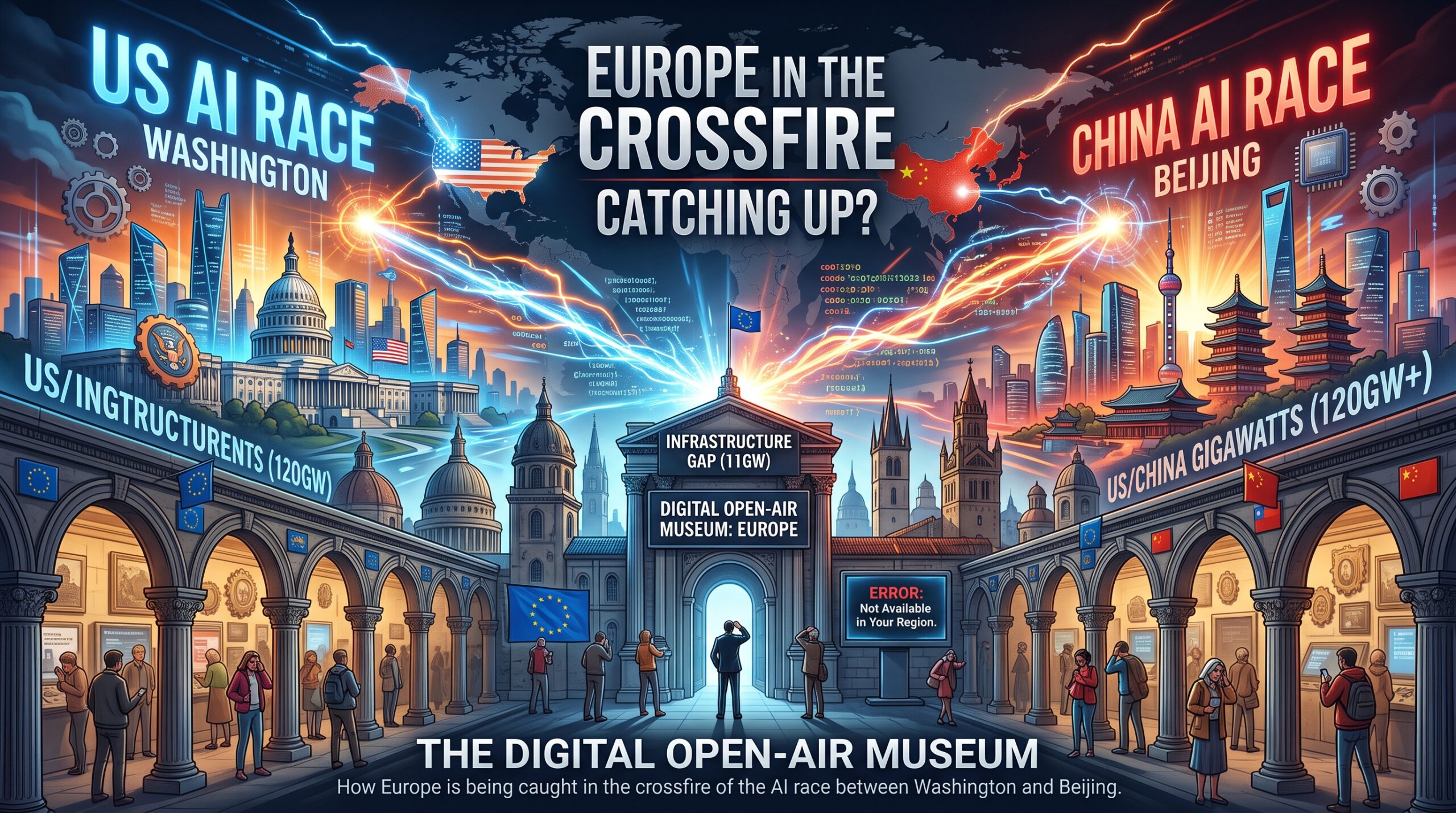
The featured image in this post, was generated by Google`s Nano Banana. The Podcast below, has been generated by Google`s NotebookLM. The Post has been generated by Google`s Gemini after extensive Chats with DeepSeek & Gemini in which I delivered the context, to make sure, that AI has enough information, to understand the scope. Each result ist always checked by me, before publishing.
EN
DE
NL
This AI podcast was generated with Google NotebookLM
There are moments when geopolitical reality is no longer just an abstract topic in business magazines, but hits you head-on at your desk on a perfectly ordinary evening after work.
My plan for this evening was simple: I wanted to integrate a modern AI feature – Google Avatar Live – into my website. The result? “Not available in your region.”
Whilst developers and companies in the US or Asia have long been integrating such technologies natively into their products, here in the heart of Europe we find ourselves paying for a premium VPN service, setting up US tunnels and fiddling with browser permissions – just to be allowed to test what the rest of the world is currently working on.
This little error message is the perfect symptom of a collective European illusion: We still believe we can regulate the world’s technological future, whilst, in terms of infrastructure and strategy, we’ve long since been sidelined.
The double pincer movement: when Plan A and Plan B collapse simultaneously
Until now, the survival strategy of European companies and AI developers has been based on a convenient division of labour:
- Plan A (US frontier clouds): We use OpenAI, Anthropic or Google via APIs for high-end applications and agentic coding.
- Plan B (Chinese open-weight models): When data protection, the GDPR or costs become an issue, we fall back on extremely powerful open models from China (such as Alibaba’s Qwen or DeepSeek) and host them locally on European servers.
Both pillars are crumbling beneath us at the very same time.
In the US, export controls, delays in the EU rollout and regulatory backtracking are already the order of the day. And anyone who hoped that China would supply the West with freely downloadable state-of-the-art models indefinitely is ignoring the geopolitical reality:
The U-turn in Beijing (research findings):
Behind closed doors, the Chinese Ministry of Commerce is discussing a strict tiered model for AI exports with tech heavyweights such as Alibaba, ByteDance and Z.ai.
Whilst simple base models will remain freely available, cutting-edge models (frontier models) are to be completely blocked from overseas access or made available exclusively as closed APIs, in the interests of national security.
Beijing is thus responding directly to the US chip sanctions: why should it give Western companies the weights of highly sophisticated models for free, whilst it is itself cut off from Western hardware?
If US cloud models are ruled out due to restrictions and the Chinese shut the door on open weights: What will Europe be left with then? A beacon of hope such as Mistral in France – admirable, but equipped with only a fraction of the global computing budget – will not be able to bridge this gap on its own.
The foundation is missing: 11 gigawatts against the rest of the world
In the debate, people are quick to reassure: “We don’t actually have to train the models ourselves; we’ll simply become world champions in applications and bring AI into our strong industrial sector.”
This is a dangerous self-delusion. AI is no longer an isolated software tool that you buy once and then apply to Excel spreadsheets. Intelligence is becoming a basic infrastructure – just like electricity, gas and water. And this infrastructure requires physical gigawatts:USA: Forecast computing capacities of well over 50 to 120 gigawatts by the end of the decade.China: Similar scales, coupled with a state-orchestrated ecosystem of hardware, data streams and robotics (Shenzhen alone is setting up huge manufacturing clusters where e-mobility and humanoid robotics converge).Europe: Is languishing at around 11 to 20 gigawatts.We can hold as many panel discussions as we like in Berlin and Brussels on ethical AI: without the physical data centres, cheap industrial electricity and the hardware, no one can build foundational models. And those who do not build models cannot dictate standards.German bureaucracy versus exponential agentsHow are our economy and public administration responding to this epoch-making shift?Small and medium-sized enterprises: Long-established companies are spending two years on internal AI guidelines and working groups, instead of live-testing a single bold use case (such as automated quotation generation or agent workflows).The judiciary: When social security courts have to handle 20 to 60 per cent more cases due to AI-generated claims by citizens, the official proposed solution is not: “We’ll automate our review processes and use AI to ease the burden on judges.” No, the call is: “We need more permanent posts and mandatory legal representation.”Bureaucracy: Whilst start-up founders in Silicon Valley set up companies online in a matter of minutes, in Germany you spend a full working day at the notary’s, have forms read out to you at a cost of tens of thousands of euros, and wait months to be able to operate legally.Conclusion: Break out of the state of shock
The comparison with industrialisation falls short in one crucial respect: When the car replaced the horse-drawn carriage, the coachmen switched to engines. But when systems outperform humans cognitively in research, coding, logic and process control, simply ‘retraining for the next office task’ won’t help.
Anyone in Europe who wants to remain competitive as an entrepreneur or developer today must not wait for politicians to fix the framework conditions.
- Radically adapt technology: Tools such as multi-agent systems, code synthesis and computer-aided use must be integrated into workflows today – not in two years’ time.
- Think pragmatically about sovereignty: Build hybrid architectures (local open-source inference in Europe wherever possible; frontier APIs where necessary).
- Stop living in the subjunctive: The question is not whether we will be overwhelmed by AI or robotics. The question is whether, in the end, we will merely be the astonished museum visitors who have to pay through the nose to rent licences from the US and China – or whether we will take matters into our own hands.
The Open-Source Illusion: Beijing Closes the Gates
While European enterprises sought refuge from US platform lock-in by adopting high-performance open-weight models from Alibaba (Qwen) or Z.ai
📄 Read the briefing document: Chat Google Gemini Preview
The videos below are in German. You can activate the subtitles im you preferred language by clicking the gearwheel.
 We need your consent to load the content of YouTube.We need your consent to load the content of YouTube.