What is Flow — and why is it the counter-philosophy to control-driven transformation?
Frustration, sustained long enough, becomes a question. And questions, pursued honestly, sometimes become frameworks.
FlowOS did not begin with a whiteboard session or a consulting brief. It began with a growing conviction — accumulated across years of working inside organisations that were trying, genuinely trying, to transform — that something fundamental was being missed. Not a tool. Not a ceremony. Something deeper.
The problem, as I came to understand it, was not that organisations were choosing the wrong methodology. The problem was that they were treating methodology as a solution — when methodology is only ever a vehicle. The question that matters is not which framework you implement. The question is whether the people inside your organisation understand why they are doing what they are doing, whether their work is connected to something that matters, and whether the system around them helps or hinders that connection.
Most transformation programmes answer none of these questions. They answer a different one: how do we appear to be transforming?
When the Framework Becomes the Problem
I have worked with Scrum. I have worked with SAFe. I have seen both applied well and applied badly — but I have come to believe that some of the most common failures are not failures of application. They are failures embedded in the design itself.
Consider what happens to a Scrum team in a large organisation that has not yet understood agile — genuinely understood it, not just learned its vocabulary. The ceremonies exist. The roles exist. But the daily standup becomes a status report to management. The retrospective becomes a performance review in disguise. The sprint review becomes a demonstration nobody acts on. The framework is present. The thinking behind it is absent.
Now imagine adding SAFe on top of this.
I have seen this happen. Teams that had not yet internalised the basics of self-organisation were suddenly required to participate in Program Increment Planning events, Agile Release Trains, and System Demos. The overhead multiplied. The confusion deepened. The distance between the people doing the work and the decisions that shaped their work grew wider, not narrower.
I said it then, and I believe it still: you cannot place a heavy framework on an unready foundation. The framework will not compensate for the missing foundation. It will simply make the cracks harder to see — and more expensive to ignore.
But my concern with SAFe goes beyond the question of readiness. It goes to structure.
In SAFe’s design, the Product Owner at team level does not own the product. They receive stories — predefined, pre-prioritised, handed down from the Agile Release Train level above. The vision, the discovery, the empathy with the customer — all of this happens somewhere above the team, managed by people who are often further from the actual user than the developers themselves.
The team executes. Someone else thinks.
This is not agility. This is Taylorism with a new vocabulary. The separation of thinking and doing — which Frederick Taylor proposed in 1911, and which the Agile Manifesto was written explicitly to counter — has been quietly reintroduced at scale, dressed in the language of transformation.
SAFe also creates something that no transformation programme should ever create: more managers. More roles. More ceremonies. More layers between intent and action. For organisations that are already struggling with the weight of their own processes, SAFe often adds load rather than removing it.
I am not arguing that SAFe never works. I am arguing that it works despite its bureaucracy, not because of it — and that for most organisations, there is a better path.
The Question That Changed Everything
At some point — not in a single moment, but gradually, through accumulated experience — I stopped asking “which framework should we use?” and started asking something different.
What does it feel like when work actually flows?
Not what does it look like on a board. Not what does it measure on a velocity chart. What does it actually feel like, for the people doing the work, when the system around them is helping rather than hindering?
The answer, when I was honest about it, was clear. Work flows when people understand why it matters. When the objective is real and connected to something the organisation genuinely needs. When discovery happens before execution — when we validate before we build. When the rhythm of work protects deep thinking rather than interrupting it. When problems surface early and are addressed honestly. When the team trusts that the system around them is designed to help them succeed, not to monitor their compliance.
None of these things require a particular framework. All of them require a particular mindset — and a particular set of practices designed to cultivate that mindset over time.
That set of practices is FlowOS.
What Flow Actually Means
Flow is not a speed metric. This is perhaps the most important misunderstanding to address at the outset.
When I use the word flow, I mean something specific: the removal of friction between intent and action. Flow is the state in which a team knows what it is trying to achieve, has what it needs to achieve it, and is not constantly interrupted, redirected, or second-guessed in the process.
Flow is not constant motion. Sometimes flow means slowing down — spending time in discovery, in empathy, in validation — before picking up speed in execution. A team that rushes into building without understanding what it is building is not flowing. It is running fast in an unknown direction.
Flow is also not the absence of structure. One of the most persistent misunderstandings about human-centred ways of working is the assumption that less structure means more freedom. In practice, the opposite is often true. The right structure — clear objectives, visible work, regular but lightweight cadence — creates the conditions for freedom. It removes the cognitive overhead of uncertainty. When people know what they are doing and why, they can focus completely on the how.
This is why FlowOS is described as an operating system, not a methodology. A methodology tells you what to do. An operating system creates the environment in which work can happen well — and then gets out of the way.
The Founding Promise
Every methodology makes a promise. Scrum promises iterative delivery and continuous improvement. SAFe promises enterprise-scale agility. Design Thinking promises human-centred innovation. OKRs promise strategic alignment.
FlowOS makes a different kind of promise — one that I believe none of these frameworks make explicitly, even though it is the one that matters most:
Transformation must release time and cognitive capacity — or it will be discarded.
This sounds simple. It is not. Most transformation programmes consume the very capacity they promise to create. They add ceremonies to already-full calendars. They require people to learn new tools while continuing to deliver on old deadlines. They ask for change while maintaining all the conditions that made change impossible in the first place.
FlowOS is designed around the opposite principle. Every element of it — the board, the cadence, the objective structure, the discovery process — is tested against a single question: does this give people more capacity, or less? If the answer is less, it does not belong in the system.
This is why FlowOS replaces five daily standups with one weekly sync. Not because meetings are bad — but because five daily interruptions to a developer’s deep work cost more than they produce. The Weekly Sync gives the team what it actually needs: a regular moment to surface blockers, align on priorities, and move forward together. Then it ends, and the work resumes.
This is also why FlowOS works with chalk on a wall. The board — whether it lives in Miro, on a physical wall, or sketched on a whiteboard — is a thinking tool, not a reporting tool. Its job is to make the work visible so the team can act on what they see. Any surface that does that job is the right surface.
What This Book Is — and Is Not
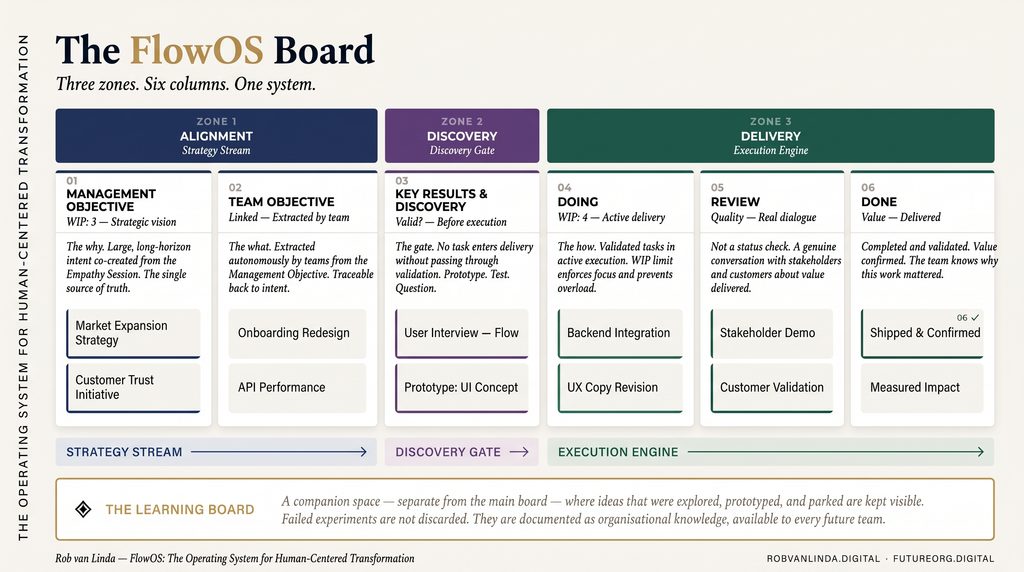
FlowOS integrates three proven approaches: Design Thinking, OKRs, and Kanban. Not stacked on top of each other, not applied in sequence, but woven together into a single coherent architecture. Each brings something the others need. Design Thinking brings empathy and discovery. OKRs bring direction and alignment. Kanban brings visibility and flow.
Together, they form what I call the FlowOS Stack — a sense-making architecture that helps organisations understand what they are trying to achieve, validate that it is worth achieving, and then deliver it with as little friction as possible.
This book is not a critique of other frameworks. It is not an argument that everything that came before was wrong. Scrum, when genuinely understood and honestly applied, produces extraordinary results. OKRs, when co-created rather than handed down, align organisations in ways that traditional goal-setting never achieves. Design Thinking, when treated as a real discipline rather than a workshop format, changes the quality of everything that follows.
FlowOS is an argument that these things work better together than apart — and that the way they are brought together matters as much as the things themselves.
It is also an argument for honesty. Transformation is hard. It takes longer than the PowerPoint suggests. It requires leadership to change behaviour, not just vocabulary. It will encounter resistance, and that resistance is often legitimate — because people who have lived through three previous transformation programmes have earned their scepticism.
FlowOS does not promise to make transformation easy. It promises to make it real.
How to Read This Book
FlowOS serves two readers, and this book is designed for both.
If you are an executive — a leader who needs to understand whether FlowOS fits your context, what commitment it actually requires, and what you can expect in return — each chapter opens with that conversation. You do not need to understand every practice to make a good decision about whether to invest in this way of working.
If you are a practitioner — a transformation lead, an agile coach, a team lead, or a consultant who needs to know exactly how to set up the board, run the Weekly Sync, write effective Management Objectives, and introduce the cadence step by step — that layer is here too, in every chapter.
You do not have to choose. Read at the depth that serves you. The thread holds either way.
The five phases of FlowOS — Empathise, Define, Discover, Realise, Scale — form the spine of what follows. Each one builds on the last. Each one addresses a question that the previous phase made possible to ask.
We start, as FlowOS always starts, with listening.
The five phases of FlowOS — Empathize, Define, Discover, Realize, Scale — form the spine of what follows. Each one builds on the last. Each one addresses a question that the previous phase made possible to ask.
On the next page, you’ll find a visualization of the board