This AI-generated video was created with HeyGen using my photo, voice clone, and an AI-assisted script.
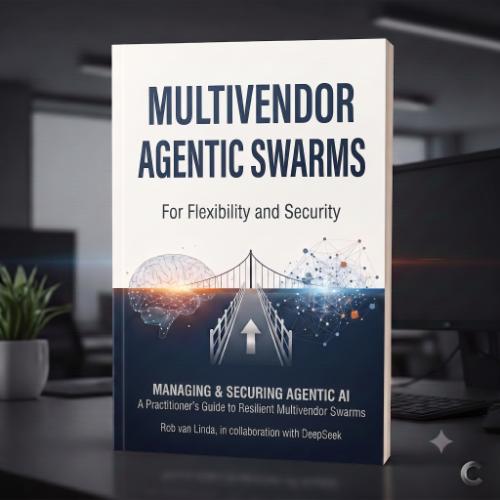
Managing & Securing Agentic AI – A Practitioner’s Guide to Resilient Multivendor Swarms
The final evolution of the roadmap: How to build an architecture that works with all models—and remains sovereign, secure, and under your control.
1. The Central Thesis: The Age of Fragmentation
Two years ago, the world of AI was still straightforward. You chose a model (OpenAI, Google), integrated it, and that was that.
Today, that is no longer enough. The world is fragmented: Europe has Mistral and Aleph Alpha, China drives development with DeepSeek and Qwen, and the US invests billions in the next generation.
The question is no longer: “Which model should I choose?”
The question is: “How do I build an architecture that works with ALL models—whilst ensuring I remain in control and secure?”
The Future does not belong to the company that has the best model. It belongs to the company that best combines and controls its models.
2. The Orchestrator: The Brain of the Swarm
A multivendor swarm is not a wild bunch of AI models working away on their own. It is controlled by an Orchestrator – a central entity that acts like a conductor in an orchestra:
-
Task Allocation: It breaks down complex queries into sub-tasks and assigns them to the appropriate models (e.g., Mistral for text, DeepSeek-Vision for images).
-
Quality Control: It checks the results and decides whether they are good enough.
-
Resource Management: It ensures no model is overloaded and costs remain within budget.
-
Communication (MCP): Models do not communicate directly. They communicate via standardised interfaces (MCP), which allows them to be easily interchanged and scaled without breaking the system.
3. The Four Pillars of a Sovereign Architecture
A robust architecture rests on four pillars—independent of the model used:
-
🔵 1. ACP (Agentic Control Protocol): Deterministic code locks for all models. Strict budget limits, pre-tokeniser filters, and emergency shutdown in the event of rule breaches.
-
🟢 2. MCP (Model Context Protocol): Standardised interfaces for all connections. Uniform API adapters, central tool registry, dynamic tool discovery.
-
🟡 3. HONL (Human-on-the-Loop): The human as the conductor of the entire swarm. Escalation for bona fide cases, dashboard with 10-second decision, prevention of approval fatigue.
-
🟣 4. Anonymisation (The Data Gateway): The digital customs officer that intervenes before data leaves the swarm. Target identification (EU vs. non-EU), three-stage anonymisation (replacement, generalisation, obfuscation).
4. The Invisible Battle: Tokens, Swarm Attacks, and Red Teaming
In a multivendor environment, tokens are the only physical keys our agents possess. Attackers do not seek to compromise your architecture—they simply wish to hijack it.
-
The Token Trap: A single faulty agent can burn through your entire budget in a single night (runaway loops, denial-of-wallet attacks). The solution is hard budget limits at code level (ACP) and pre-tokeniser filters.
-
The Asymmetric Race: Attackers are not bound by ethics or compliance. They evolve at lightning speed. The only answer is disciplined aggression: You must deploy your own digital profilers (AI Red Teaming) to simulate thousands of attacks against yourself. Use the same speed and ruthlessness as the attacker—but exclusively against your own sandbox, to close vulnerabilities before they do.
5. Physical Sovereignty: The Foundation Beneath the Foundation
Sovereignty is not just a question of code—it is also a question of physical resources. A company that operates a sovereign architecture must be aware that its fourth pillar is based on the availability of energy, independence from geopolitical supply chains, and the ability to plan this infrastructure to be resilient in the long term.
Technological sovereignty does not end at the API call interface—it begins right at the power socket to which the server is connected.
This is the final book of the roadmap. It closes the loop: From the seed (OrgDNA) to the human foundation (FlowOS), preparation (HB4L), security (Safe in the Swarm), and now full orchestration (Multivendor Agentic Swarms).
But I am fully aware of the fact, that this ibook will really be my final one. The world is envolving in light-speed and new challenges will apprear in the very near future. But that’s what makes this worl dso fascinating. These five books provide a stable foundation that prepares companies for change and enables long-term resilience.
< Click here, to go back to the book overview page
To read or download the book, click here Mutlivendor-agentic-en-GB