This AI-generated video was created with HeyGen using my photo, voice clone, and an AI-assisted script.
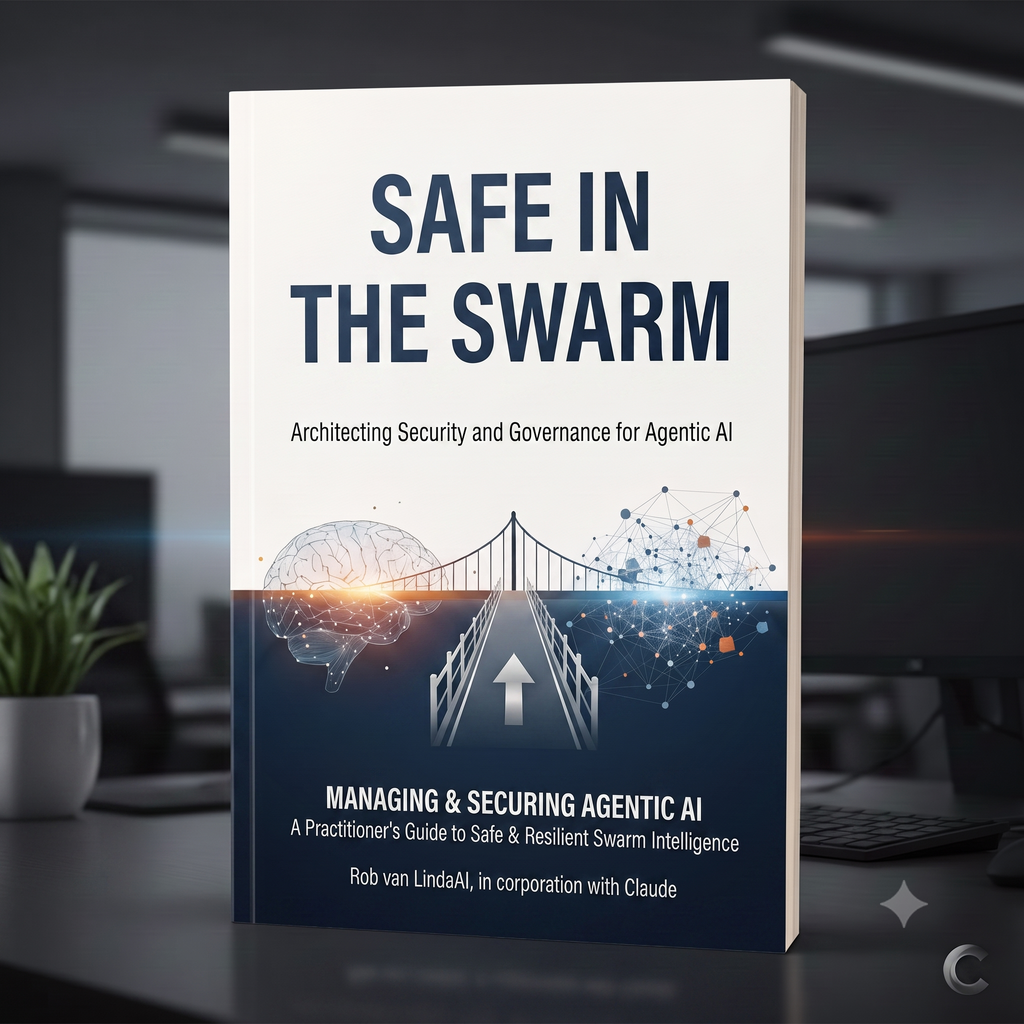
Safe in the Swarm
Responsibility, Judgment, and Work in the Age of AI
The next evolution in the roadmap: How to build a robust architecture that keeps autonomous agent swarms secure, cost-efficient, and under human control.
1. The Reality Check: Why 80% of Transformation Happens Before the First Agent Goes Live
If you are hoping for a magic button, put this book down. AI agents do not fail because of a lack of intelligence—they fail because of a lack of rigor in their architecture.
Before the first agent is unleashed, you must face the **”Slide Deck Syndrome”** and the **”Data Graveyard”**. An AI model is a high-performance stochastic engine. If you bolt it onto a rusty soapbox of sloppy processes, contradictory data, and unclear responsibilities, it will not achieve efficiency—it will scale your chaos at the speed of light.
The Week 4 Crash: In the first two weeks, you celebrate the demos. By week four, you are clearing up the mess in the ERP system because the agent got stuck in an infinite loop, used outdated data, or burned through the entire API budget.
2. The Core Architecture: The Holy Trinity of Agentic Security
To survive in the swarm, you must separate the **connection to the world** from the **control of actions**.
🔵 MCP (Model Context Protocol): The universal socket. It gives the agent the dynamism, reach, and power to interact with the real world (databases, emails, APIs).
🟢 ACP (Agentic Control Protocol): The deterministic brake. MCP ensures the plug fits; ACP ensures the device doesn’t set the house on fire. It is a hard-coded code barrier that stops actions at the network level. No discussion, no interpretation, no grey area. A 403 Forbidden.
🟡 The Gatekeeper: The digital filter for the outside world. It strips hidden commands (Indirect Prompt Injection) from PDFs, emails, and websites before the reasoning agent ever sees them.
The Iron Rule: Prompts control an agent’s efficiency and tone. But never its rights, its limits, or its security.
3. Human ON the Loop: The Conductor’s Dashboard
Stop tilting at windmills. Humans must neither act as a brake within the data stream (HITL) nor be completely outside the system (HOTL).
The target model is Human ON the Loop (HONL), exactly like an air traffic controller:
- Green Zone: The agent runs autonomously 95% of the time on routine, low-risk tasks.
- Yellow Zone (Bona Fide): Business exceptions and uncertainties. The agent prepares a perfect decision proposal for the human, and the human decides in 10 seconds via a 3-zone dashboard (Context, Argumentation, Control).
- Red Zone (Mala Fide): Malicious attacks or rule-breaking. No human needs to approve here. The ACP and Gatekeeper implement a deterministic, hard block instantly.
4. The Economics: The Token Trap & FinOps
An agent that doesn’t know what it’s allowed to forget will burn through your money faster than it makes decisions. AI models are not oracles; they are token-consuming engines.
To keep the swarm affordable, you need:
- Context Pruning: Summarize and strip old memories so the model doesn’t reprocess half your book with every keystroke.
- Model Cascading & Routing: Don’t use a V12 engine to sort emails. Use a cheap, fast model for simple tasks, and only activate the flagship model for complex reasoning.
- Semantic Caching: Don’t pay for the same answer twice.
5. The Global Context: Why Europe Must Lead in Sovereignty The world is dividing into digital vassalage and digital sovereignty. The Patriot Act, FISA 702, and the CLOUD Act allow US authorities direct access to data stored in US AI and cloud infrastructure.
The Multivendor Agentic Swarm is the answer: An ecosystem of European AI models (Mistral, Aleph Alpha), EU clouds (OVH, Hetzner), and standardised protocols (MCP/ACP) working together. No single point of failure. No US access to data. A symphony of sovereignty.
< Click here, to go back to the book overview page
To read or download the book, click here safe in the swarm_2.0 en-GB >