This AI-generated video was created with HeyGen using my photo, voice clone, and an AI-assisted script.
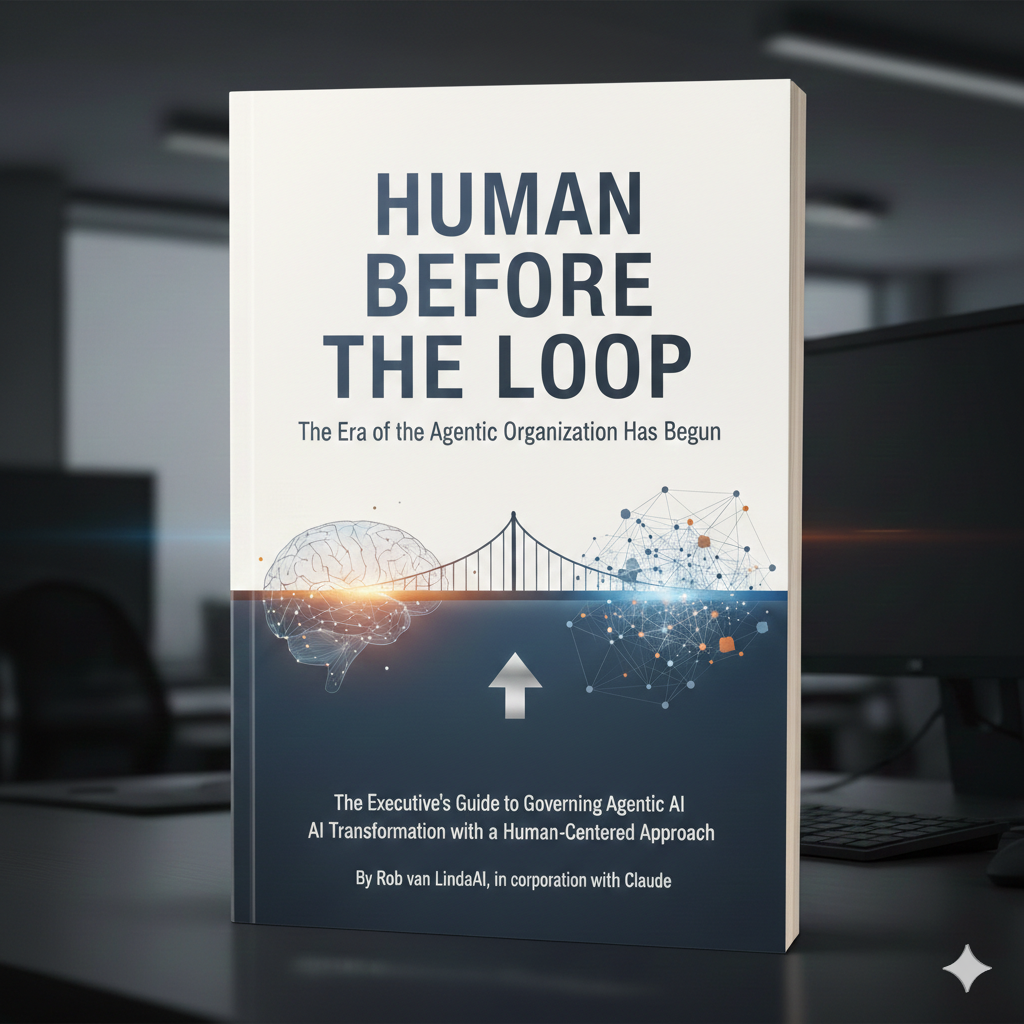
The Executive’s Guide to Governing Agentic AI with a Human-Centered Approach.
The next evolution after FlowOS: How to architect, prepare, and govern autonomous agents with human responsibility at the core.
1. The Architecture of Intent: “As much as necessary, as little as possible”
Before you configure a single MCP, before you write a single line of governance, you must answer the foundational questions: What is the vision? Why do we need an agent at all?
Not because it is trendy, not because a vendor promised a 10x increase, but because there is a specific, human-defined problem that requires continuous, automated attention. Once the vision is clear, you design the minimal architecture.
You do not build a swarm because you can. You ask: What is the simplest structure that achieves this vision? Maybe it is just one sub-agent. Maybe it is a single tool. Maybe it is no agent at all, and the problem is better solved by a human with better data. The Human is the Architect.
2. The Core Concepts of Governance
Once the architecture is defined, the guardrails must be built. These are the four pillars of HB4L:
-
🟣 OrgDNA: The “cognitive constitution” of your organization. Who are we? How do we think? What do we protect at all costs? (Every agent inherits this before it acts).
-
🔵 MCP (Model Context Protocol): The “keychain”. What is this agent allowed to do? What tools and data can it access? (Fewer keys = less risk and less confusion).
-
🟢 ACP (Agent Communication Protocol): The “CSS file” of your governance. The central, universal rules that apply to every agent, regardless of individual setup.
-
🟡 A2H (Agent to Human): The “escalation path”. What happens when an agent hits a boundary? There are 5 types (Inform, Collect, Authorize, Escalate, Result) – and the human must be prepared to respond.
3. The Unbreakable Rule: “No Agent Without a Human Name”
In HB4L, there is a strict governance rule that defines the entire philosophy: Every single agent must have a named human owner.
Not a department. Not a committee. A specific person. If an agent fails, there is no “system error” to blame. There is a name in the agent registry. That person is responsible for the agent’s configuration, its behavior, its updates, and its final decommissioning. This is not about blame; it is about accountability.
By making this rule visible, HB4L proves that AI does not replace human intelligence—it requires it. The human is the architect, the guardrail, and the ultimate decision-maker. The agent can run autonomously at high speed, but it is always bound to a human context.
4. The Data Trust Card: “No Card, No Access”
Data is like a spice rack. Without a label, an expiration date, and a cleaning schedule, a database turns into a dangerous pantry. The Data Trust Card is your governance instrument for the data layer.
It gives every data source a label, a human owner, a classification, and an expiration date.
-
The Gatekeeper Principle: If a data source doesn’t have a fully validated Data Trust Card, it does not enter the vector space.
-
The Rule: “What is not actively renewed, is rigorously deleted.”
-
The Result: Your agents are not making decisions on stale, unvalidated information. The data layer becomes a source of truth, not a source of hallucination.
Ready to move from preparation to scale? The next book in the roadmap is Safe in the Swarm – how to step into the bird’s-eye view and maintain security across multiple agents.
< Click here, to go back to the book overview page
To read or download the book, click here Agetnic AI Transformation Handbook for Leaders-2026 >